

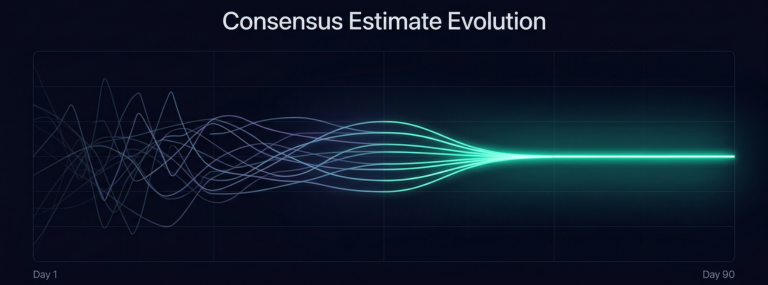
Wall Street analysts rarely get it right on the first try. Their earnings predictions shift constantly as new data emerges, companies report quarterly results, and economic conditions evolve. Understanding how these consensus estimates change over time can give investors a significant edge in timing their trades and spotting trends before the broader market catches on.
The 90-day window offers a particularly revealing snapshot of analyst sentiment. It’s long enough to capture meaningful shifts in expectations but short enough to remain actionable for most investment strategies. This timeframe typically spans the gap between quarterly earnings reports, making it ideal for tracking how professional opinions evolve as new information surfaces.
Why Analyst Consensus Estimates Matter
When analysts revise their earnings forecasts, they’re incorporating fresh information that the market hasn’t fully digested yet. This is where users of WealthNX are able to get a headstart over the mass market. A single analyst changing their price target might mean little, but when the consensus moves in one direction, it signals that something fundamental has shifted in how Wall Street views a company’s prospects.
Analysts tend to adjust their forecasts incrementally rather than making large revisions all at once, even when fundamentals have materially changed. This creates a drift in stock prices as the market gradually incorporates improving or deteriorating stock outlook. This
The power of consensus estimates lies in their aggregation of expert opinion. When 20 analysts covering a stock all independently raise their forecasts, they’re collectively identifying positive business momentum that casual observers might miss. This collective intelligence, when properly interpreted, becomes a valuable signal in the noise of daily market movements.
The Anatomy of Estimate Changes
Consensus estimates don’t move in straight lines. They follow predictable patterns throughout the earnings cycle. Early in a quarter, estimates tend to be optimistic as analysts build in growth assumptions based on management guidance and favorable industry tailwinds. As the quarter progresses and companies provide guidance updates or pre-announce results, those forecasts typically drift downward in a phenomenon known as the “analyst walk-down.”
This pattern creates opportunities for astute investors. Companies that manage to beat even lowered expectations often see their stocks surge as the market recalibrates upward. The relief rally that follows can be substantial, especially when negative sentiment had built up heading into the earnings release. Conversely, missing already reduced estimates sends a particularly negative signal about underlying business health and management’s ability to forecast their own operations.
The walk-down pattern varies by sector. Technology companies often see more volatile estimate changes as product cycles and competitive dynamics shift rapidly. Consumer staples typically show more stable estimate patterns, though macroeconomic factors like inflation can trigger sudden consensus shifts across the entire sector.
Reading Between the Lines
The magnitude of the estimate changes matters as much as the direction. A 2% upward revision across the board suggests modest optimism, perhaps reflecting slightly better than expected same-store sales or margin improvement. A 15% jump indicates analysts believe they fundamentally misunderstood the company’s trajectory, possibly due to a new product launch exceeding expectations or a major contract win that wasn’t previously modeled.
The same logic applies to downward revisions, but with even greater implications. Large negative revisions often reflect structural problems rather than temporary headwinds. When analysts slash forecasts by double digits, they’re signaling that previous assumptions about market share, pricing power, or cost structure were fundamentally flawed.
Sector-wide estimate changes deserve different interpretation than company-specific moves. When oil and gas analysts collectively slash estimates, it likely reflects commodity price movements rather than individual company execution. These revisions tell you more about the macro environment than operational performance. But when one retailer sees estimates climb while competitors stay flat, that company is probably taking market share or executing a superior strategy that’s creating separation from the pack.
The Revision Velocity Factor
Beyond the magnitude of changes, the speed of revisions provides additional insight. Gradual estimate increases over 90 days suggest sustained positive momentum and analyst confidence in the trajectory. Sudden spikes in estimates might reflect a one-time event that won’t necessarily continue. Smart investors distinguish between sustainable trends and temporary blips.
Tracking the dispersion of analyst estimates also matters. When forecasts cluster tightly, it suggests strong consensus and lower uncertainty. Wide dispersion indicates analysts are struggling to model the business, which often correlates with higher stock volatility and risk. Companies undergoing major transformations or operating in rapidly evolving industries typically show greater estimate dispersion.
Technology Transforms Estimate Tracking
Traditional investors relied on quarterly analyst reports and financial news to track consensus changes, often receiving information days or weeks after institutional traders. Today’s platforms aggregate this data in real time, making it accessible to retail investors who previously lacked these insights. The information advantage that once belonged exclusively to professional money managers has largely disappeared.
WealthNX leverages similar technology to help users synthesize analyst opinions with other data points, creating a more complete picture of investment opportunities. By combining estimate revision data with fundamental metrics, technical indicators, and sentiment analysis, modern platforms provide a multidimensional view of stocks that was unimaginable just a decade ago.
The democratization of Wall Street research has leveled the playing field substantially. Individual investors can now spot estimate trends as quickly as institutional traders, though they still need the skills to interpret what those trends mean and the discipline to act on them appropriately. Access to data is no longer the constraint; analytical capability and emotional control now separate successful investors from the rest.
Common Pitfalls to Avoid
Not all estimated revisions carry equal weight, and understanding these nuances prevents costly mistakes. Analysts covering companies in their investment bank’s portfolio face conflicts of interest that can bias their forecasts upward. When the same firm underwrites a company’s debt or advises on acquisitions, their research analysts face subtle pressure to maintain positive outlooks. Independent research firms often provide more objective views, though they lack the access to management that bulge bracket analysts enjoy.
Timing matters tremendously in interpreting revisions. An estimate revision immediately after earnings carries less predictive power than one made mid-quarter when analysts have digested new information beyond the quarterly report. The market has already absorbed post-earnings revisions into stock prices, but mid-quarter changes can signal shifts the broader market hasn’t recognized yet.
Another pitfall involves mistaking noise for signal. In thinly covered small-cap stocks, a single analyst revision can swing the consensus dramatically without reflecting any genuine change in business fundamentals. Require multiple analysts moving in the same direction before considering it a meaningful trend.
Building an Estimate-Tracking Strategy
Successful investors don’t just monitor estimate changes for stocks they already own. They scan for unusual patterns across entire sectors, using estimate revisions as a discovery tool for new opportunities. A cluster of upward revisions in semiconductor stocks might indicate strengthening demand before it shows up in earnings reports, giving early movers a chance to position ahead of the crowd.
Setting up alerts for significant estimate changes creates a systematic approach to opportunity identification. Define what “significant” means for your strategy, whether that’s revisions exceeding 5%, changes affecting more than 60% of covering analysts, or sustained momentum in estimate direction over multiple weeks. Different approaches work for different investment styles, from aggressive growth strategies to conservative value investing.
Combining estimate tracking with other metrics creates a more robust investment process. Look for stocks where estimate revisions align with improving fundamentals like accelerating revenue growth or expanding margins. The confluence of multiple positive signals typically generates better risk-adjusted returns than relying on estimate changes alone.
Frequently Asked Questions
How often do analysts typically revise their estimates?
Most analysts update their forecasts quarterly after earnings releases, but significant company announcements or sector developments can trigger mid-quarter revisions. Active coverage typically means 8-12 estimate updates per company annually, with more frequent updates for volatile growth stocks and less frequent changes for stable mature companies.
What percentage change in consensus estimates is considered meaningful?
Revisions exceeding 5% generally signal substantial changes in expectations. However, context matters significantly as high-growth tech companies naturally see larger swings than stable utility stocks. A 3% revision for a utility might be more meaningful than a 10% change for a speculative biotech.
Do estimate revisions work better for certain market caps?
Large-cap stocks with extensive analyst coverage tend to show more reliable patterns since the consensus reflects broader opinion. Small-cap estimate changes can be more volatile but potentially more actionable when spotted early, as these stocks often fly under the radar until institutional investors discover them.
How long does it take for estimate changes to affect stock prices?
Markets typically begin pricing in consensus changes within days, though the full impact may take weeks to materialize as more investors recognize the trend. Algorithmic trading systems now monitor estimate changes and can move stocks within hours of revisions hitting terminals.
References
Standard & Poor’s Global Market Intelligence analyst forecast data FactSet Research Systems consensus estimate methodology Bloomberg Terminal analyst rating aggregation systems Financial Industry Regulatory Authority (FINRA) analyst conflict of interest guidelines Journal of Financial Economics research on analyst forecast accuracy