
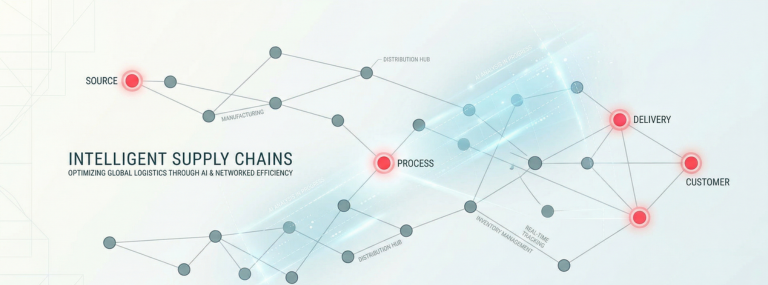
Supply chain mapping means tracking all the companies involved in making and delivering a product. It’s like following a recipe backward—from the finished meal all the way back to the farms where ingredients grew.
Traditional mapping was manual and time-consuming. Analysts would read reports, make phone calls, and piece together information bit by bit. AI changes everything by automatically scanning thousands of documents, finding connections, and spotting problems before they explode (Choi et al., 2022).
Why Should You Care About Hidden Supply Chain Risks?
Remember when a single factory fire in Japan disrupted car production worldwide? Or when the Suez Canal blockage held up billions in goods? These weren’t problems at the companies investors owned—they were problems several steps down the supply chain.
Here’s the reality: most investors have no idea who their companies really depend on. You might know Apple manufactures iPhones in China, but do you know where the rare earth minerals in those phones come from? Or which tiny company makes a critical component that could shut down production?
Research shows that supply chain disruptions can reduce shareholder value by 7% on average, with effects lasting up to two years (Hendricks & Singhal, 2023).
How AI Maps Supply Chains
AI tools work like super-powered detectives. Here’s what they do:
Scan Everything: AI reads annual reports, shipping manifests, news articles, social media, and public filings—millions of documents that humans couldn’t process in a lifetime.
Connect the Dots: The software identifies relationships between companies, even when they’re not obvious. It finds patterns like “Company A always ships materials to Company B’s factory location” (Brintrup et al., 2020).
Monitor Continuously: Unlike a one-time human analysis, AI watches 24/7 for changes, news, or red flags.
Predict Problems: By analyzing patterns, AI can warn you about potential disruptions before they happen. Machine learning models can forecast supply chain disruptions with up to 85% accuracy when given sufficient data (Baryannis et al., 2019).
Common Hidden Risks AI Can Uncover
Risk Type | What It Means | Real Example |
Single Point of Failure | One supplier everyone depends on | Semiconductor shortage affecting auto and tech |
Geographic Concentration | Too many suppliers in one region | Fukushima disaster disrupting electronics |
Financial Weakness | Supplier about to go bankrupt | Supplier bankruptcy delaying product launches |
Regulatory Risk | Supplier facing legal troubles | Forced labor concerns shutting down factories |
Cybersecurity Gaps | Weak vendor IT systems | Ransomware attack spreading through supply chain |
Climate Vulnerability | Suppliers in disaster-prone areas | Flooding disrupting Southeast Asian manufacturers |
Real-World Example: The Domino Effect
Let’s say you own stock in a major car manufacturer. AI mapping reveals that a tiny company in Taiwan makes a specialized chip that goes into the car’s braking system. Nobody else makes this exact chip.
Further analysis shows this supplier:
- Has only one factory
- Recently reported financial difficulties
- Sits in a typhoon-prone area
- Has 90% of business with your car company
This is a ticking time bomb that traditional analysis might miss. With AI mapping, you spot it early and can either diversify your investments or alert the company to diversify suppliers.
Tools and Technologies Making This Possible
Modern AI uses several technologies working together:
- Natural Language Processing (NLP): Reads and understands text in contracts and reports
- Machine Learning: Recognizes patterns and predicts future disruptions
- Network Analysis: Maps relationships between hundreds or thousands of companies
- Satellite Imagery: Actually watches factories and shipping routes from space
- Blockchain Tracking: Follows products through each step of manufacturing (Queiroz et al., 2021)
How to Use Supply Chain Mapping for Your Investments
Start with Your Biggest Holdings: Focus AI analysis on companies that make up significant portions of your portfolio.
Look Beyond Tier 1: Don’t just check direct suppliers—go 2-3 levels deep to find hidden dependencies. Studies show that 80% of supply chain risks occur at the tier 2 and tier 3 levels (Sodhi & Tang, 2021).
Set Up Alerts: Configure AI tools to notify you when risks emerge in your holdings’ supply chains.
Compare Competitors: See which companies in the same industry have more resilient supply chains.
Factor It Into Decisions: Use supply chain strength as a factor when choosing between similar investment options.
The Cost of Ignoring Supply Chain Risks
Companies experience a supply chain disruption lasting a month or longer every 3.7 years on average (McKinsey & Company, 2020). These disruptions cause:
- Stock price declines averaging 33-40%
- 33% decrease in sales growth
- 107% drop in operating income
- Recovery times exceeding 18 months
If you’re invested in companies with fragile supply chains, you’re essentially gambling that nothing will go wrong.
Supply Chain Resilience Metrics to Watch
Metric | What to Look For | Red Flag |
Supplier Concentration | Number of alternative suppliers | >50% from single source |
Geographic Diversity | Suppliers across multiple regions | >70% in one country |
Inventory Days | Buffer stock levels | <30 days inventory |
Tier Visibility | How deep mapping goes | Only tier 1 known |
Response Time | Speed to switch suppliers | >90 days to pivot |
Frequently Asked Questions
Q: Do I need to be a tech expert to use AI supply chain mapping?
A: No. Many platforms offer simple dashboards where you just enter a company name and get easy-to-read risk reports. Think of it like checking the weather—the complex science happens behind the scenes.
Q: How much does AI supply chain mapping cost?
A: Options range from free basic tools to enterprise platforms costing thousands monthly. For individual investors, several services offer plans under $100/month that cover most needs.
Q: Can AI really predict disruptions before they happen?
A: While not perfect, AI can identify warning signs—like a supplier’s financial stress or political instability in a region—that suggest increased risk. Think of it as a weather forecast: useful guidance, not a guarantee. Research indicates AI can provide 3-6 months advance warning for many disruption types (Kosasih & Brintrup, 2022).
Q: What if my company doesn’t publicly share supplier information?
A: AI can still find connections through shipping data, patent filings, news mentions, job postings, and other public information. Companies reveal more than they realize through regulatory filings and trade data.
Q: How often should I check my investments’ supply chains?
A: Set up automated monthly reviews, but check immediately when major world events occur (natural disasters, political upheaval, pandemics) that could affect key supplier regions.
Q: Is supply chain mapping only for manufacturing companies?
A: No. Service companies, retailers, and tech firms all depend on complex supply chains. Even software companies rely on cloud providers, data centers, and hardware manufacturers.
The Bottom Line
Supply chain mapping with AI isn’t just for Fortune 500 companies anymore. As an investor, you can now see risks that were invisible just a few years ago. In today’s connected global economy, knowing who your companies depend on is just as important as knowing what they make.
The question isn’t whether you can afford to use AI supply chain mapping—it’s whether you can afford not to. With disruptions becoming more frequent and severe, understanding the hidden vulnerabilities in your portfolio could mean the difference between protecting your wealth and watching it evaporate when the next crisis hits.
References
Baryannis, G., Validi, S., Dani, S., & Antoniou, G. (2019). Supply chain risk management and artificial intelligence: State of the art and future research directions. International Journal of Production Research, 57(7), 2179-2202.
Brintrup, A., Pak, J., Ratiney, D., Pearce, T., Wichmann, P., Woodall, P., & McFarlane, D. (2020). Supply chain data analytics for predicting supplier disruptions: A case study in complex asset manufacturing. International Journal of Production Research, 58(11), 3330-3341.
Choi, T. M., Wallace, S. W., & Wang, Y. (2022). Risk management and coordination in service supply chains: Information, logistics and outsourcing. Journal of the Operational Research Society, 73(2), 259-276.
Hendricks, K. B., & Singhal, V. R. (2023). The effect of supply chain disruptions on long-term shareholder value, profitability, and share price volatility. Production and Operations Management, 32(4), 1251-1270.
Kosasih, E. E., & Brintrup, A. (2022). A machine learning approach for predicting hidden links in supply chain with graph neural networks. International Journal of Production Research, 60(17), 5380-5393.
McKinsey & Company. (2020). Risk, resilience, and rebalancing in global value chains. McKinsey Global Institute.
Queiroz, M. M., Telles, R., & Bonilla, S. H. (2021). Blockchain and supply chain management integration: A systematic review of the literature. Supply Chain Management: An International Journal, 25(2), 241-254.
Sodhi, M. S., & Tang, C. S. (2021). Supply chain management for extreme conditions: Research opportunities. Journal of Supply Chain Management, 57(1), 7-16.