

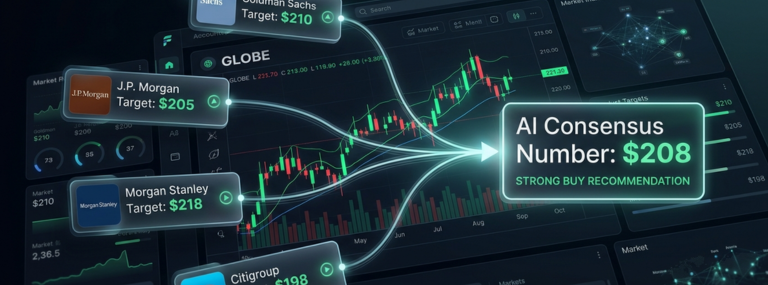
Ever wonder what Wall Street’s analyst price targets are? You’re not alone. Millions of investors scroll through endless analyst reports, trying to piece together whether Tesla’s headed to $500 or $200. The problem? These predictions are scattered across dozens of brokerage sites, paywalled research reports, and conflicting headlines.
That’s where AI-powered aggregation tools are changing the game entirely.
The Old Way of Tracking Analyst Targets
Remember the days of manually checking each brokerage’s website? You’d pull up Goldman’s take on Apple, then hop over to Morgan Stanley, maybe check what JPMorgan said last week. By the time you’d compiled everything into a spreadsheet, the market had already moved.
Traditional financial sites improved things by listing targets in one place, but they still left investors doing the heavy lifting. You’d see a table of numbers with no context about which analysts have the best track record, whether recent upgrades signal momentum, or if institutional money is actually following these predictions.
How AI Transforms Price Target Analysis
Modern AI tools don’t just collect analyst targets—they make sense of them. These platforms pull data from hundreds of Wall Street firms simultaneously, tracking every upgrade, downgrade, and price revision the moment it happens.
But here’s where it gets interesting. The best AI systems go beyond simple averages. They analyze historical accuracy, weigh recent revisions more heavily than stale predictions, and identify patterns that humans might miss. When three top-rated analysts raise their targets within 48 hours, that’s a signal worth noticing.
WealthNX AI takes this approach further by combining analyst sentiment with alternative data sources and market patterns. Instead of just telling you what analysts think, it spots opportunities emerging before they become front-page news. That edge matters when you’re competing against institutional investors with billion-dollar research budgets.
What Makes These Aggregation Tools Actually Useful
The magic happens in three key areas. First, speed. Getting analyst updates in real-time rather than reading about them in tomorrow’s financial news can mean the difference between buying at $50 or $55.
Second, context. Knowing that analysts have a $100 average price target means nothing without understanding the distribution. Are all twelve analysts clustered around $95-105? Or is it six saying $75 and six saying $125? AI platforms break down consensus, outliers, and conviction levels automatically.
Third, integration. The smartest tools connect price targets with actual insider trading, institutional ownership changes, earnings surprises, and technical patterns. When analyst optimism aligns with insider buying and improving fundamentals, you’ve got a stronger case than any single data point alone.
Finding Opportunities Before the Crowd
Here’s something most investors miss: by the time CNBC reports “analysts raise price targets on XYZ stock,” it’s often too late. The institutional buyers who move markets have already acted on that information.
WealthNX AI addresses this timing problem by identifying emerging patterns before they hit mainstream coverage. The platform’s algorithms detect subtle shifts in analyst sentiment—maybe coverage initiations from respected firms, or a steady drumbeat of small target increases that haven’t triggered headlines yet.
This approach mirrors how professional traders operate. They’re not reacting to news; they’re positioning ahead of it. When you spot three analysts quietly raising targets while the stock trades sideways, that divergence creates opportunity.
The Data Quality Problem
Not all price target aggregators are created equal. Some free platforms update sporadically, miss smaller brokerage firms, or fail to account for analyst turnover. You might be looking at a target set by someone who left the firm six months ago.
Premium platforms maintain relationships with data providers, ensuring comprehensive coverage and real-time updates. They also track analyst performance history—something crucial that basic aggregators ignore. An analyst with a 75% accuracy rate deserves more weight than someone who’s been wrong on eight of their last ten calls.
WealthNX AI prioritizes data quality by sourcing from institutional-grade feeds and cross-referencing multiple providers. When accuracy matters, cutting corners on data isn’t an option.
Making Sense of Conflicting Targets
What do you do when Morgan Stanley says “buy” with a $200 target while Bank of America says “sell” at $120? This happens constantly, and AI tools help navigate these conflicts intelligently.
Advanced platforms analyze why targets differ. Maybe the bearish analyst is weighting near-term headwinds while the bull focuses on long-term margin expansion. Understanding these divergent views helps you form your own thesis rather than just picking the number you like best.
The goal isn’t finding the “right” price target—it’s understanding the range of possibilities and what would need to happen for each scenario to play out.
Beyond Just Stock Picks
While price targets grab attention, the real value comes from tracking changes over time. A stock with steadily rising targets quarter after quarter tells a different story than one where analysts keep slashing expectations.
Smart investors watch for inflection points. When negative sentiment finally bottoms and analysts start cautiously upgrading, those early turns often signal the best entry points. Similarly, when euphoric targets keep climbing despite weakening fundamentals, that’s your cue to get defensive.
FAQ
How often are analyst price targets updated? Major brokerages update targets around earnings releases, significant company announcements, or material changes in their outlook. AI aggregators typically reflect these changes within hours.
Do higher price targets mean I should buy? Not necessarily. Price targets represent where analysts think a stock could trade over 12-18 months, not guaranteed returns. Always consider the target relative to current price, the analyst’s track record, and supporting fundamentals.
Can individual investors access the same analyst data as institutions? Premium AI platforms like WealthNX provide retail investors with institutional-quality data and analysis that was previously available only to professional money managers.